


A current ballot performed by Galaxy Digital researcher Christine Kim revealed that there are important misunderstandings throughout the Ethereum group concerning the financial safety of the blockchain. The ballot requested the crypto group to guage the safety thresholds for ETH used to safe the blockchain, demonstrating a lack of understanding of the particular danger of assaults.
Respondents polling Demonstrates the next beliefs about Ethereum’s safety:
- 44.9% imagine that securing Ethereum requires 100% collateralization of all ETH, totaling $110 billion, or 31.4 million ETH.
- 20.4% imagine that 66.6% of pledged ETH is sufficient, equal to $73.4 billion, or 20.9 million ETH.
- 34.7% imagine that solely 33.3% of staked ETH, or $36.7 billion, or 10.4 million ETH, must be used for safety.
How fragile is Ethereum?
In response to those misconceptions, Christine Kim highlighted the precise vulnerabilities of Ethereum’s proof-of-stake (PoS) mechanism in an in depth follow-up report from X. Kim emphasised, “You don’t want 100% ETH to assault Ethereum. 33% is sufficient to destroy the ultimate consequence, 50% is sufficient to lengthen the chain cut up, 66% is sufficient to double spend”.
She added, “Safety relies upon totally on the community’s potential to punish stakers by destroying massive quantities of locked worth. The extra extreme the assault, the larger the worth stakeholder loss. It’s essential to grasp what’s actually at stake right here (pun completely supposed) language).”
Additional elaboration from the Ethereum Basis explains the technical foundation for these vulnerabilities. An article from the inspiration cited by Kim famous that “attackers use >= 33% of complete fairness Making the entire beforehand talked about assaults extra prone to succeed… 33% of staked Ethereum is a baseline for attackers as a result of so long as this quantity is exceeded they’ve the power to stop the chain from being finalized with out having to finely management the actions of different validators . “
For the assaults concerned 34% of complete fairnessThe article particulars a potential situation of “double finality”, during which an attacker can concurrently manipulate the verification of two conflicting blockchain forks. This type of assault is characterised by intensive coordination and management of message timing throughout the community, posing a excessive danger because the attacker’s total stake could also be considerably decreased.
Increased ranges of managed staking, e.g. 50% and 66%, growing the probability of extra extreme disruptions, together with ongoing chain splits and transaction censorship or reversal. The muse’s article explains, “An attacker can dominate the fork selection algorithm when greater than 50% of the whole stake…permits the attacker to censor sure transactions, carry out short-range reorganizations, and modify blocks of their favor. Reorder to extract most MEV.”
Defenses towards these threats embrace “inactivity leaks,” a mechanism that step by step reduces the quantity of ether staked by non-participating or malicious validators, and a social consensus layer among the many Ethereum group that if a cut up happens, the chain will proceed exist.
These revelations underscore the significance of group consciousness and technical assurance in sustaining the safety and integrity of the Ethereum community. They emphasised that whereas Ethereum’s PoS system gives quite a lot of safety benefits, it additionally requires vigilant monitoring and preparation for potential assaults.
3 tendencies in ETH staking
Because the Ethereum staking panorama evolves, a number of key tendencies have emerged that reshape the way in which stakeholders work together with and profit from the staking course of.
Tom Wan, 21.co researcher, highlight These are in a current article by X:
- Elevated recognition of remortgaging: Since 2024, the Ethereum ecosystem has seen a significant shift in the direction of re-staking. The re-staking contribution has been elevated from 10% to 60% of the whole quantity of ETH staked. Eigenlayer, specifically, has turn out to be the second largest DeFi protocol on Ethereum, holding $15 billion in complete worth locked (TVL), accounting for 13% of all staked ETH.
- Lido’s market share declined: The rise of liquidity-heavy pledge protocols has clearly affected Lido’s dominant place within the Ethereum pledge market. Lido’s share has fallen under 30% as a result of development of recent platforms resembling Etherfi, which has turn out to be the second largest withdrawr of stETH since 2024, with a complete of 108k stETH withdrawals.
- Centralized trade (CEX) staking decreases: Centralized exchanges’ dominance in ETH staking has declined, falling from 29.7% to 25.8% since 2024. Kiln Finance lately surpassed Binance to turn out to be the third largest ETH staking entity. Ether.fi can also be making progress and is anticipated to additional problem Binance’s earlier dominance within the close to future.
As of press time, ETH is buying and selling at $3,526.
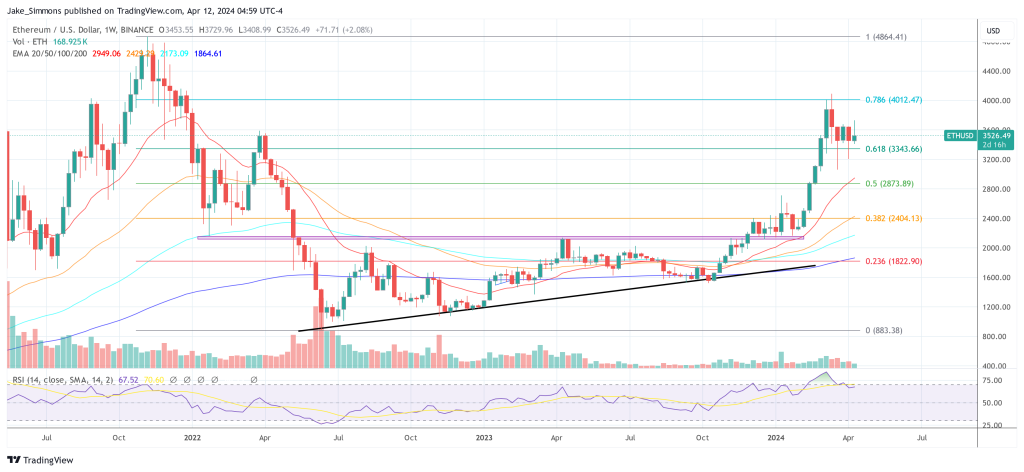
Featured picture created with DALL·E, chart from TradingView.com
